
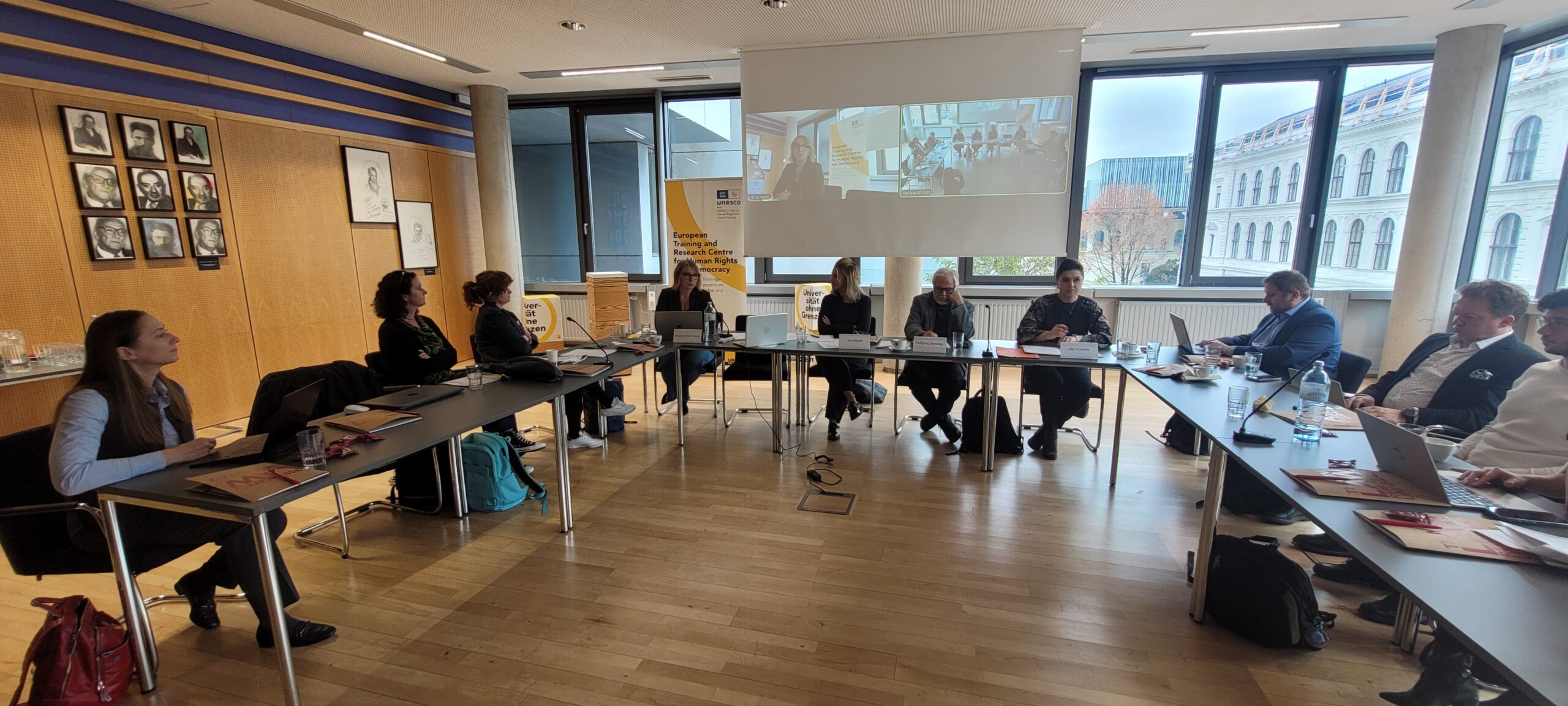
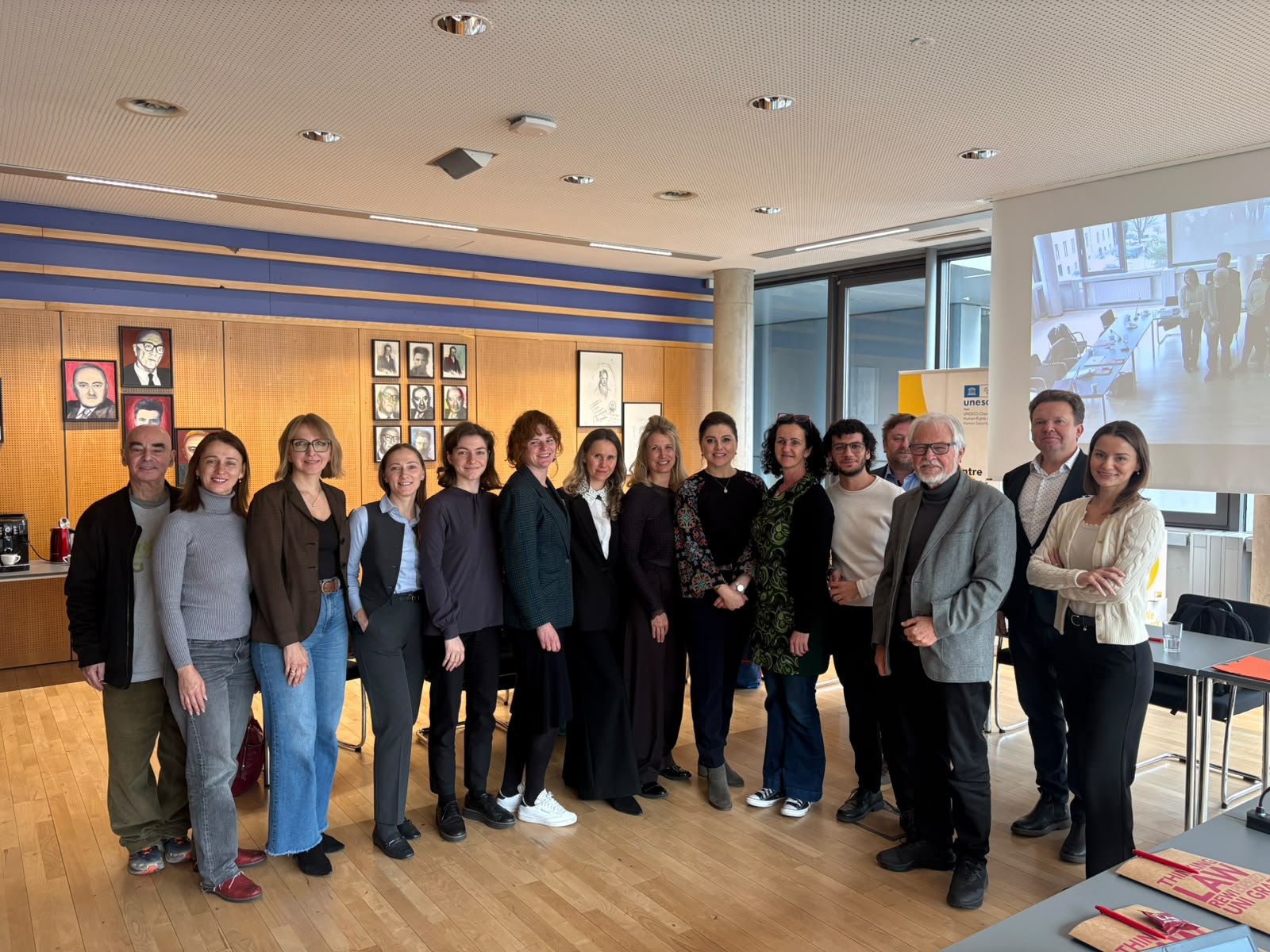
On 10 November 2026, the Erasmus+ project Promoting Academic Freedom in Ukraine (FreeAc) held its final dissemination event, “From Resilience to Transformation: A Strategic Outlook for Ukrainian Higher Education,” at the University of Graz, Austria. The event brought together project partners, academics, policymakers and higher education stakeholders to discuss the project’s results and future priorities for Ukrainian higher education.
Hosted by the European Training and Research Centre for Human Rights and Democracy (UNI-ETC) at the University of Graz, the event took place in a hybrid format and attracted 73 participants, including 20 in person and 53 online.
The event marked the culmination of nearly three years of cooperation among eight partner organisations from Austria, Ukraine, Poland, Italy and Greece, working together to promote academic freedom, strengthen institutional resilience and support Ukrainian higher education during Russia’s ongoing war against Ukraine.
Presenting the FreeAc Strategic Outlook
The central part of the event was the presentation of the Strategic Outlook for Ukrainian Higher Education: From Resilience to Transformation, developed by WUS Austria as part of the FreeAc project.
The document builds on the project’s key research and educational activities, including the Baseline Study on displaced Ukrainian academics, the Teaching Gap Analysis, the Joint Research Report on the effects of the armed conflict on Ukrainian higher education, and the expert consultations held in Palermo in April 2026.
The Strategic Outlook identifies six interconnected priorities for the future of Ukrainian higher education:
- Transforming brain drain into brain circulation.
- Protecting academic freedom and institutional autonomy.
- Deepening European integration.
- Rebuilding research capacity and knowledge production.
- Building resilient and sustainable universities.
- Strengthening universities’ role in recovery and democratic development.
Looking towards 2035, the document proposes a flexible framework for supporting Ukrainian higher education through continued uncertainty, recovery and long-term transformation.
Panel Discussion: From Recommendations to Action
A key highlight of the event was the panel discussion “Ukrainian Higher Education under Prolonged Uncertainty – From Recommendations to Action,” moderated by Dr Lisa Heschl (University of Graz).
The panel brought together speakers representing different perspectives on Ukrainian higher education:
- Prof. Dr Wolfgang Benedek (University of Graz), contributing expertise on academic freedom, human rights and international academic cooperation.
- Dr Maryna Mruga (Ministry of Education and Science of Ukraine, Representative of Ukraine to the Bologna Follow-Up Group), bringing the perspective of national higher education policy and European integration.
- Prof. Dr Oksana Illnar-Vusyk (President of the Ukrainian Science Diaspora in Austria, USciDA), addressing the role of academic diaspora networks and brain circulation.
- Dr Alla Krasulia (Sumy State University), providing insights into the challenges faced by Ukrainian universities operating under prolonged wartime conditions.
- Aqim Emurli (WUS Austria/Kosovo, online), contributing comparative perspectives from higher education reform and international cooperation in post-conflict contexts.
The discussion focused on the practical implementation of the Strategic Outlook’s recommendations. Participants explored which measures could be advanced during the ongoing war, how international partnerships could support institutional resilience, and how displaced academics could remain connected to Ukrainian universities through research, teaching and academic cooperation.
Particular attention was given to the importance of supporting academic communities that continue to work in Ukraine, alongside opportunities for strengthening European cooperation and rebuilding research capacity.
Building on Three Years of Cooperation
The final dissemination event was followed by the final FreeAc Consortium Meeting, providing partners with an opportunity to review the project’s achievements, discuss its concluding activities and consider how its results could continue to be used.
Over nearly three years, FreeAc has brought together Ukrainian and European institutions through joint research, academic exchanges, educational activities and policy dialogue. The project’s findings highlight that protecting academic freedom requires not only legal safeguards but also functioning universities, institutional resilience, sustained international cooperation and support for academic communities.
Although the project is coming to an end, its research findings, Strategic Outlook and international partnerships provide a foundation for continued cooperation in support of Ukrainian higher education.
The FreeAc consortium thanks all speakers, participants and partners for their contributions to the final event and throughout the project.